
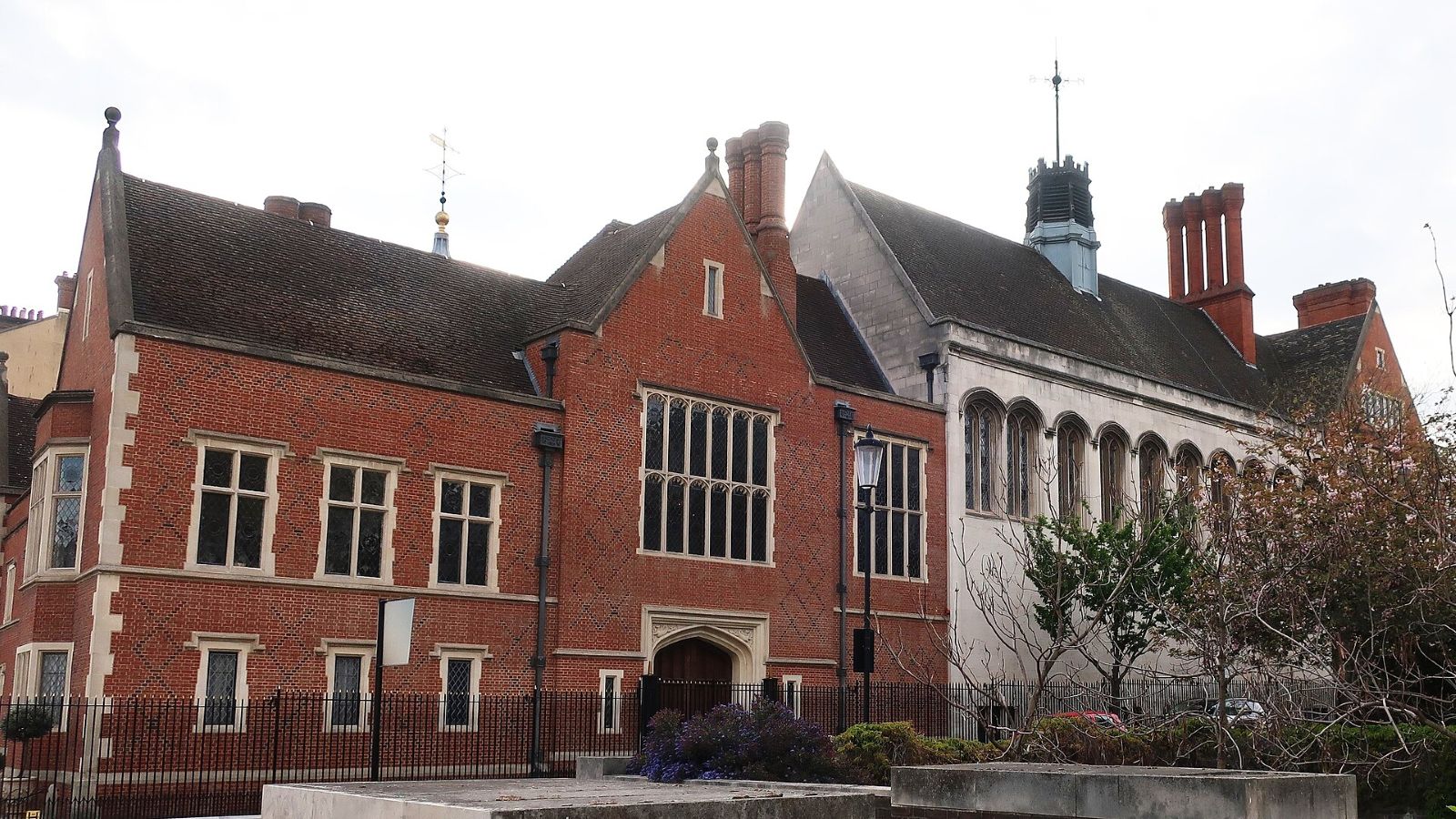
In 1908, men went into a warehouse on Bishopsgate with chalk and stencils and began writing numbers on a fifteenth-century oriel window. Every stone got a mark. Every roof timber got a mark. Then they took the whole thing apart and put it into storage, and eighteen months later it went back up again four miles away, in Chelsea, in an orchard that had belonged to Sir Thomas More.
The building is still there. You can stand on Cheyne Walk and look at it.
What almost nobody looking at it knows is that they are looking at the London headquarters of Richard III – the rooms from which the most contested seizure of the English throne was organised – and that it was later bought, held for eight months, and sold at a third of profit by the man whose book destroyed Richard’s name for five hundred years.
The Highest House in London
John Crosby was a grocer. That word does less work in the fifteenth century than it does now; Crosby traded wool, sat as an alderman, went on diplomatic business, and sat in Parliament. In 1466 he renewed a lease from the prioress of St Helen’s in Bishopsgate, took in some adjacent properties, and agreed to pay £11 6s 8d a year. Then he pulled down what was on the land and built.
John Stow, writing over a century later, called it very large and beautiful, and the highest at that time in London. That last clause is the one that matters. Height was the boast.
Crosby was knighted in 1471 for helping hold the city against Thomas Fauconberg. The house took until about 1472 to finish and he died in 1476, which gave him four years in the tallest building in London. His effigy is still lying in St Helen’s Bishopsgate beside his first wife Agnes, a few hundred yards from where the hall used to be and four miles from where it is.
Gloucester’s Spring
By the early 1480s the house had become the London base of Richard, Duke of Gloucester.
In May 1483 he came down from York. His brother Edward IV was five weeks dead. His nephew, twelve years old, was Edward V in name and in the Tower in fact, lodged there as kings traditionally were before a coronation. Anne, Richard’s duchess, arrived in London on 5 June. On 6 July, Richard was crowned king.
Everything in between – the setting aside of a boy king, the execution of Hastings, the parliamentary manoeuvring, the arrival of a claim about a pre-contract that made the entire royal family illegitimate – was run out of a merchant’s house on Bishopsgate, because that is where the Protector was living.
Shakespeare knew the address and used it. In the second scene of Richard III, Gloucester tells Anne to go to Crosby Place, and later in the play the house is named again as the place to find him. Millions of people have heard the name spoken from a stage. A very small number of them know that the building is real, that it survived, and that it is now a private residence with a garden in SW3.
Eight Months and Fifty Pounds
On 1 June 1523, Thomas More paid £150 to the executors of Sir John Rest for the lease of Crosby Place.
In January 1524 he sold it to Antonio Bonvisi, a Lucchese merchant and banker, for £200. Eight months. Fifty pounds. Roughly a third on his money, and the Survey of London’s editors, who went through the deeds, doubt he ever spent a night under the roof.
That is the whole of the great association between Sir Thomas More and Crosby Hall, and almost every account you will read implies something warmer – More at his desk in the great hall, More writing Utopia by its windows. He wrote Utopia elsewhere. He wrote The History of King Richard III elsewhere too, somewhere around 1513 to 1518, years before he had anything to do with the building. What he did at Crosby Place was turn it over for a profit.
The arrangement with Bonvisi was not quite a straight sale. Bonvisi leased the place back to More’s son-in-law William Roper and his nephew William Rastell, and because the title sat with an Italian banker rather than with More, the Crown had nothing to seize there when More went to the block in 1535. More called Bonvisi, in one of his last letters out of the Tower, the most faithful of his friends, and said he had been for nearly forty years not a guest of that house but a nursling of it.
So: the man who blackened Richard III made fifty pounds on Richard’s house and arranged his affairs well enough that Henry VIII could not get at it.
The case against a dead king
More was five years old in 1483. He wrote his account of those events some thirty years later, under the son of the man who had killed Richard at Bosworth, and he never finished it or published it. Edward Hall took it. Holinshed took it from Hall. Shakespeare took it from Holinshed and gave us the hunchback, the withered arm, the smothered children, the whole apparatus of the stage villain.
Thomas Costain, in The Last Plantagenets, the final volume of his Pageant of England sequence, put the defence at length and put it well, and anybody who wants the full argument should go and read him. The short version runs like this.
Richard had already destroyed his nephews’ claim by statute. Titulus Regius declared Edward IV’s marriage invalid on the grounds of a prior contract with Eleanor Butler, which made the children bastards, and bastards do not inherit. Killing two boys he had legislated out of the succession gained him nothing he did not already have and risked everything he had just acquired. That is not a motive. That is the opposite of one.
Then there is Edward, Earl of Warwick, Clarence’s son, a boy with a claim as strong as the princes’. Richard kept him alive and kept him in his household. Henry VII cut his head off in 1499. One of those two men killed his nephew, and it was not the one Shakespeare wrote about.
And in March 1484, Elizabeth Woodville walked out of sanctuary at Westminster and let her daughters go to Richard’s court. Whatever that woman believed at that moment, she did not believe she was handing her daughters to the man who had smothered her sons the previous summer.
The honest difficulty is the silence. Buckingham’s rebellion in October 1483 was aimed initially at restoring Edward V, which tells you Richard was not as secure as a clean version of this argument needs him to be, and once the rumour started that the boys were dead, Richard could have ended it inside a day by producing them. He never did. From the outside, a man who has mislaid his nephews and a man who has murdered them look exactly the same, and that single fact has kept the argument alive for five centuries. It is the strongest card the prosecution holds and it is not nothing.
It is also not a body, a witness, or a document. What the prosecution actually has is a literary composition by a boy of five, written a generation afterwards, for a regime whose legitimacy depended on the answer.
Serving the master
None of which makes More a liar, exactly, or Shakespeare one. Both men were working.
More was building a career under Henry VIII and writing in a genre – the moral history, the tyrant’s rise and fall – where the shape of the story governs the facts rather than the other way round. Shakespeare’s company played at the court of Elizabeth, whose grandfather had taken the crown off Richard’s corpse at Bosworth. A playwright in London in 1593 who wanted to keep working did not write a sympathetic Richard, and it is not obvious that it would have occurred to him to want to.
In 2012 the king came out of a council car park in Leicester. The skeleton had severe scoliosis, so the twisted back the Tudors sneered at turned out to be real. The withered arm was not. Those two findings, sitting side by side in the same set of bones, are as good an account of Tudor historiography as anyone has managed: a true detail, worked up into a deformity, hung on a man who could no longer object.
The other thing More was
He wrote his own epitaph, at Chelsea, while he was alive, and he recorded in it that he had been troublesome to thieves, murderers and heretics.
Molestus. He put heretics in a list with murderers, and the point of writing it down was that he was pleased about it. Six men were burned during his chancellorship. He held suspects at his own house. The Confutation of Tyndale’s Answer runs to enormous length and is not the work of a man doing something distasteful under duress.
The saint came later. The 1960 version – conscience against the state, the last honest man – came later still.
Ambassadors, Fire and a Warehouse Floor
Catherine of Aragon lodged there with her Spanish household in 1501, newly landed and on her way to marry Arthur. Sir John Spencer bought it in 1594, ran his mayoralty from it and entertained Elizabeth. It held Royalist prisoners during the Civil War, and the East India Company rented rooms in it.
Then the fire of 1672 took most of the mansion and left the great hall and the parlour wing standing.
After that the descent is quick. Presbyterian meeting house. Warehouse, with a floor driven straight through the middle of the great hall at mezzanine height so the space could hold more goods. By the nineteenth century the most important surviving secular medieval building in London was a place to keep stock in.
Four Miles West
The Bank of India bought the Bishopsgate site to build its headquarters, and the hall was in the way.
What happened next was strange enough that it is worth following exactly. The bank paid, at considerable expense, to have the architectural features taken down, numbered and put into store. It then gave the stones and the timber away to the London County Council. The Council leased a plot on Danvers Street in Chelsea to a body called the University and City Association of London Limited, and the Association put the hall back up there under Walter Godfrey, between 1909 and the summer of 1910. At no stage did any one party own both the building and the ground beneath it. The hall was, for about eighteen months, a numbered pile of masonry belonging to a local authority.
And what went up in Chelsea was not the building that came down in Bishopsgate. What survived the journey was a kit: the roof, the oriel window, some other windows with fragments of walling between them, a fireplace and a postern door. Godfrey designed everything else around them. The original facing was Reigate stone, too soft to be trusted a second time, so the hall was refaced in Portland with the window dressings in Bath stone. The surface you look at is Edwardian. The bones behind it are not.
The listing, when it came in 1954, covered the 1910 work as well as the medieval fabric, which is the official way of admitting that the two can no longer be separated.
Belgian refugees were housed in it during the First World War, and Henry James, who saw them there, wrote about the roof arching over it all. Godfrey came back in 1925-6 to add a north wing as a hall of residence for the British Federation of University Women, and the Duchess of York opened it in 1926. In 1988 Christopher Moran bought the place and spent the next three decades restoring and extending it. It was renamed Crosby Moran Hall in 2021.
Going to Look at It
It is a private house. You cannot go in, and there is no point pretending otherwise.
What you can do is walk Cheyne Walk and look at it properly from the pavement, with Roper’s Garden on one side and More’s Garden on the other, both named for the family whose orchard this was. Chelsea Old Church is a minute away; the chapel More commissioned survived the bomb that took most of the rest of the building in 1941, and the carved capitals in it carry his devices.
Then, if you want the other end of the story, go to St Helen’s Bishopsgate, where John Crosby is lying in effigy, and find the plaque on the office block that stands where his hall stood.
The tallest house in London is now a private residence in Chelsea, refaced, extended, renamed, and standing on ground that belonged to a man who owned it for eight months, never lived in it, made fifty pounds on it, and wrote the book that turned its most famous occupant into a monster.
